


In the global race toward a hydrogen economy, the conversation usually centers on two things: color (Green vs. Grey) and cost. While the world is eager to shift to Green Hydrogen, the price of production remains the "Elephant in the room."
At BioH2 Tech, we’ve identified that the real barrier isn't just the source of the hydrogen—it’s the temperature at which we produce it.
This recognition isn't just an award; it is a validation of our mission to bridge the gap between world-class laboratory research and industrial-scale decarbonization.
The Thermal Tax: Why $1,200^{\circ}C$ is the Enemy
Traditional Waste-to-Hydrogen methods, such as gasification, are "thermal-heavy." To break the molecular bonds of organic waste and turn them into gas, industry standards require extreme temperatures ranging from $700^{\circ}C$ to $1,200^{\circ}C$.
Maintaining these temperatures requires massive energy inputs. This creates a paradox: you end up burning a significant amount of energy just to create "clean" energy. This "Thermal Tax" is exactly why Green Hydrogen has historically been too expensive for mass-market adoption.

The BioH2 Shortcut: A New Path via Catalysis
Under the leadership of Professor Zhao Jun—ranked among the World’s Top 2% Scientists—our research group at Hong Kong Baptist University (HKBU) asked a simple question: What if we could cheat the thermometer?
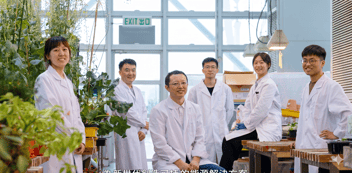
Watch the demonstration of our proprietary catalytic reforming process at the Hong Kong Baptist University laboratory.
The answer lies in our proprietary Heterogeneous Catalyst. In simple terms, our catalyst acts like a "molecular key." Instead of using brute-force heat to break apart biowaste, the catalyst lowers the energy barrier of the chemical reaction.
This allows us to achieve high-purity hydrogen reforming at just $180^{\circ}C$ and 3MPa.
What $180^{\circ}C$ Means for the Market
For an industrial operator or a municipal leader, the drop from $1,200^{\circ}C$ to $180^{\circ}C$ isn't just a scientific curiosity—it’s a massive economic win:
- Lower Opex: Reducing reaction temperatures by over $500^{\circ}C$ leads to an immediate 40% reduction in energy consumption.
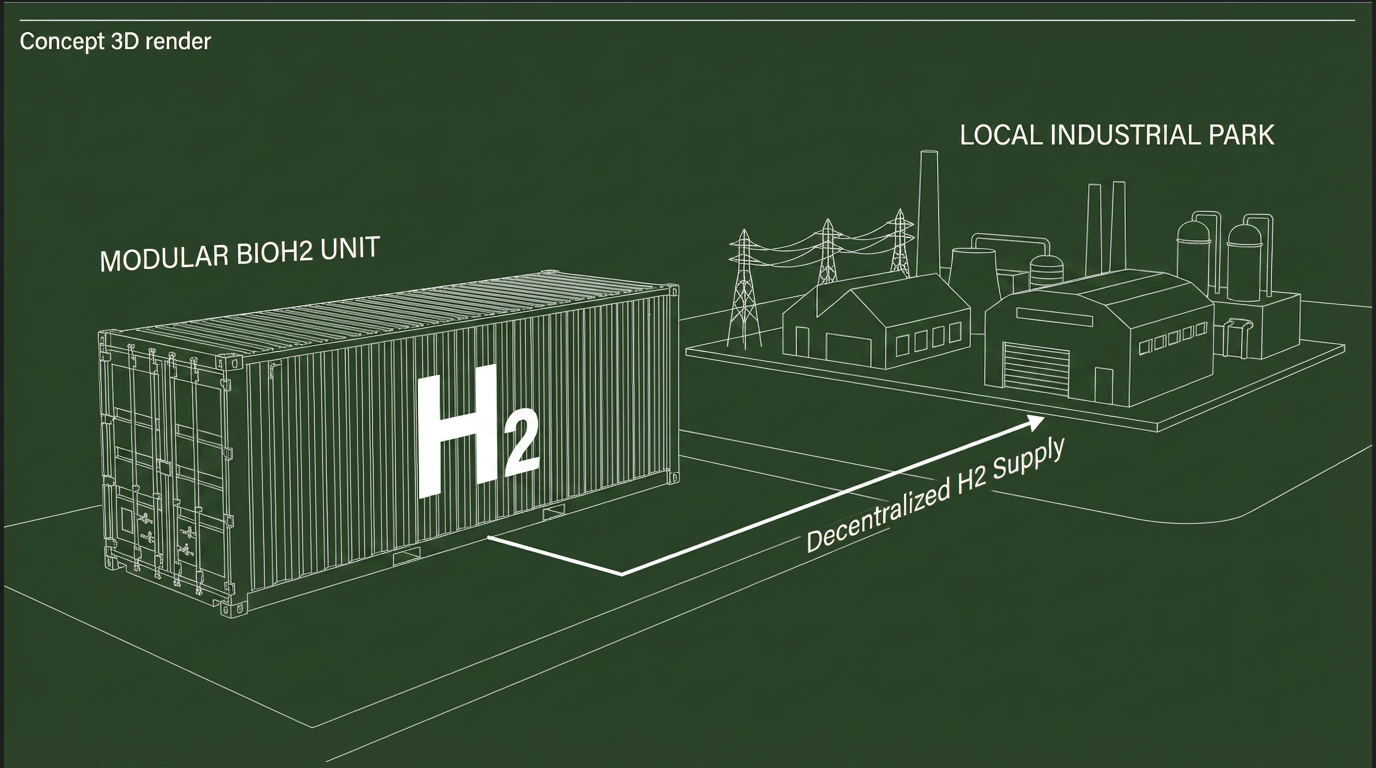
- Modular Scalability: High-temperature plants require massive, specialized infrastructure. Because our process is "low-heat," we can build modular, decentralized units that fit directly into existing industrial parks.
- Feedstock Flexibility: Our catalyst is "intelligent." It can process mixed biowaste—food waste, paper, and certain plastics—simultaneously, eliminating the need for expensive pre-sorting.
Bridging Lab and Industry
This breakthrough is the result of over a decade of research supported by the National Natural Science Foundation of China (NSFC) and the Innovation and Technology Commission (ITC). It is a prime example of "Deep Tech" moving from the faculty lab to the global market.
By removing the "Thermal Tax," we are moving Green Hydrogen from a luxury "future fuel" to a practical, affordable reality for the circular economy today.
Ready to Decarbonize Your Operations?
BioH2 Tech is currently accepting inquiries for our 2026 Pilot Programs. See how our $180^{\circ}C$ catalyst can replace diesel and reduce your carbon footprint.
Inquire for Pilot Project Participation